September 23, 2026 - Dissecting the Takeaways from the UN General Assembly
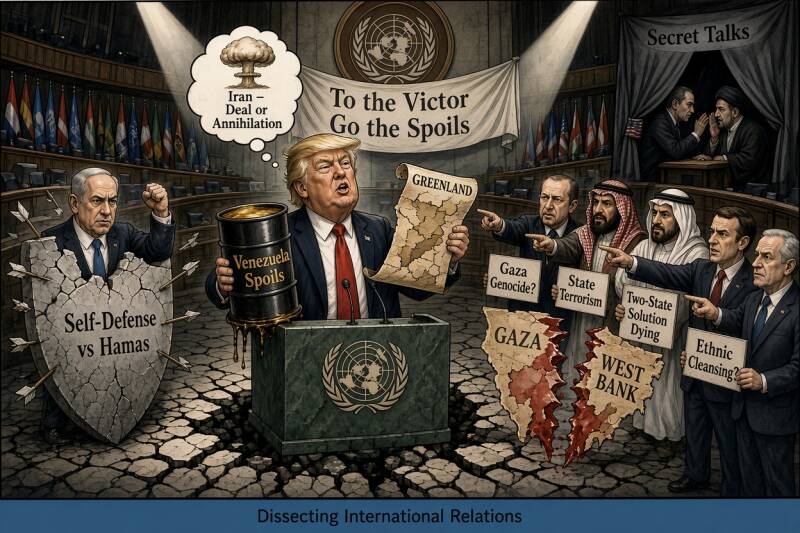
The UN General Assembly has been underway in New York, with striking statements from heads of state that warrant closer examination. Beyond the rhetoric lies deeper questions about the changing contours of global power and the interests shaping international diplomacy. What these statements reveal about the priorities and ambitions of states may be as consequential as the policies they articulate.
One of the most striking statements were those made by U.S. President Donald Trump who ‘threatened the annihilation of Iran if its leaders refuse to strike a deal and framed the U.S. as conquerors of Venezuela, while promoting himself as a problem solver in his speech to the United Nations General Assembly in New York on Tuesday. “To the victor go the spoils,” Trump told the crowd, touting an oil deal with Venezuela after he launched a military operation removing its authoritarian leader in January. The president’s remarks at the global summit kicked off a whirlwind day that included a secret meeting between U.S. officials and the Iranian delegation, with the two sides at an impasse nearly seven months into the war. Trump also signed an agreement with Denmark and Greenland that ended a standoff over his threats to invade or annex the Arctic island … U.S. officials met with the Iranian delegation for three hours on Tuesday, Trump told reporters, pointing to his top envoy for negotiations Steve Witkoff. The president’s son-in-law, Jared Kushner, also attended the meeting. “I feel very good right now,” Witkoff said, hesitating to answer reporters’ questions about the talks. Iranian officials have not confirmed whether the meeting took place. Iranian President Masoud Pezeshkian and Foreign Minister Abbas Araghchi were in town for the summit. Earlier, Trump had laid out a stark choice for Tehran in his speech to the U.N. — a deal to give up their nuclear program and reap investments from the U.S., or risk annihilation. “Do I drive them into hell with no chance of survival and no hope of future greatness for generations?” Trump posed to the global body and suggested Iran was waiting to see if he is in a weakened position after the midterms in November. “I gave absolutely no credence and will not give credence to the election when it comes to Iran,” he said’ (The Hill.2026). As Laura Kelly, Julia Manchester and Filip Timotija have found, President Trump presented the U.S. as a decisive global power, indiciating that the removal of Venezuela’s leader and subsequent oil deal as evidence of American strength. He also threatened Iran with severe consequences if Tehran refuses to abandon its nuclear programme. The speech was followed by reported secret talks between U.S. and Iranian officials, suggesting a contrast between Trump’s confrontational rhetoric and ongoing diplomatic efforts.These statements highlight a more coercive and transactional approach to diplomacy, where military power and economic leverage are used alongside negotiations. It raises questions about sovereignty, international norms, and the risks of escalation, particularly where public threats coexist with behind-the-scenes diplomatic engagement.
The UN General Assembly also featured world leaders mounting pressure on Israel over the war in Gaza. Eli Leon notes that, ‘the opening day of the 81st UN General Assembly general debate highlighted Israel’s growing diplomatic isolation on Tuesday, as a succession of world leaders made the war in Gaza, Israeli policy in the West Bank, and Israeli activity across the region central themes of their speeches. Among the most prominent critics were Turkish President Recep Tayyip Erdogan, Jordan’s King Abdullah II, Qatari Emir Tamim bin Hamad Al Thani, French President Emmanuel Macron, British Prime Minister Andy Burnham, and Brazilian President Luiz Inacio Lula da Silva. The general debate opened on Tuesday, September 22, as part of the UN leaders’ week in New York.The outgoing UN secretary-general was the first to speak and the first to criticize Israel. Antonio Guterres devoted a substantial portion of his address to sharp criticism of Israel’s actions in Gaza and the West Bank. Guterres began by condemning Hamas’s October 7 attack, which he described as an “abhorrent” terrorist attack, but said it was followed by an Israeli offensive in Gaza that led to “a scale of death and destruction I have not seen in all my years as secretary-general.” He cited the provisional measures issued by the International Court of Justice in the case against Israel and called on all sides to comply with international law and the court’s decisions. At the same time, Guterres criticized Israeli policy in the West Bank, warning that violence, the displacement of Palestinians, and settlement expansion were “crushing the path to peace” and, in his words, raising the “specter of ethnic cleansing.” He also called for the UN and aid organizations to be allowed to operate in Gaza and for their workers to be protected, warning that continued developments on the ground could effectively lead to the disappearance of the two-state solution. One of the sharpest attacks came, as expected, from the Turkish president. Erdogan accused Israel of “state terrorism” in Gaza and claimed that the Strip had become “the most inhumane and shameful concentration camp of our time.” He said the number of people killed in Gaza, including women and children, could no longer be regarded as a collateral consequence of the war. “We are facing a genocidal mindset that is never satisfied with killing,” he said. Erdogan broadened his criticism to include the West Bank and Jerusalem. He spoke of “violence and terrorism” by settlers and claimed that Muslims and Christians were being harmed in their access to holy sites. The Turkish president called on countries that have not yet recognized a Palestinian state to reconsider their position and urged the international community to increase pressure on Israel in order to enable the reconstruction of the Gaza Strip and advance the diplomatic process. Jordan’s King Abdullah II focused on the claim that Israel is systematically changing realities in Gaza and the West Bank. He accused the Israeli government of prolonging the fighting and placing obstacles in the way of US President Donald Trump’s efforts to advance an agreement. Abdullah said that for decades the international community had chosen “to manage the conflict, not confront it,” and that Israeli measures initially perceived as temporary had gradually become permanent policy. He said reality was being altered in the two arenas in different ways: in Gaza through destruction, and in the West Bank through “de facto annexation.” The goal, he claimed, was “to make a viable Palestinian state impossible.” Qatar’s Emir Tamim bin Hamad Al Thani also used particularly harsh language. He said what had taken place in Gaza was “genocide in the fullest sense of the word” and “a stain of shame on the conscience of humanity.” He argued that the test of the international community was its ability to restrain what he described as Israeli aggression, not only in Gaza but also in the West Bank, Lebanon, and Syria. The emir also criticized calls in Israel to encourage Palestinian emigration from Gaza, which he said were in practice an attempt to impose displacement. He accused Israel of failing to meet commitments connected to the ceasefire, the withdrawal of troops, and the expansion of aid deliveries, and declared that it was impossible to speak of a just international order “as long as Palestine remains a blind spot within it.” Israel rejects allegations that it is committing genocide and says its operations are directed against Hamas and are being conducted in accordance with the laws of war. French President Emmanuel Macron adopted a critical line, although one more restrained than that of the region’s leaders.“What is our credibility worth if we remain inactive in the face of Gaza?” he asked, calling the situation in the Strip “a spectacle that shames us all.” Macron also criticized increasing settler violence in the West Bank and argued that it was harming Palestinian rights and the prospects of reaching a two-state solution. The French president sparked anger in Jerusalem after claiming that Hamas was not active in the West Bank. Later, a French diplomatic source told The Jerusalem Post that Macron's comments had been mistranslated: the statement was translated as "Hamas has never been particularly active," but the meaning of the French phrase stated by Macron, "le Hamas n'a jamais sévi en Cisjordanie," is "Hamas has never governed the West Bank." British Prime Minister Andy Burnham began by condemning the October 7 attack and stressing that Britain stood alongside Israel and Jewish communities in the face of threats from Iran and Hamas. However, he added: “This does not justify the actions of the Israeli government in Gaza or the West Bank.” Burnham said London “will not stand by” while Palestinian suffering continues and the chances of a two-state solution are eroded.He particularly criticized construction plans in the E1 area and defended his government’s decision to impose restrictions on activity connected to settlements’ (The Jerusalem Post.2026). The 81st UN General Assembly highlighted growing international criticism of Israel over the war in Gaza and policies in the West Bank. World leaders such as Erdoğan, King Abdullah II, Qatar’s Emir Tamim, Macron, and Burnham condemned Israel’s military actions, settlement expansion and treatment of Palestinians, while emphasizing international law and the two-state solution. UN Secretary-General Guterres similarly warned that developments in Gaza and the West Bank undermined prospects of peace. Israel strongly rejected allegations of genocide and maintained that its operations target Hamas and comply with international law. The debate underscores Israel’s growing diplomatic pressure and the widening gap between its position and that of several influential states. It may increase calls for accountability, humanitarian access and Palestinian statehood, while further complicating efforts toward a two-state solution. These divergent positions may further expose divisions within the international community over international law, accountability, and the prospects for a two-state solution.
As the UN General Assembly comes to its conlcusion later this week, talks so far reflect an international order increasingly shaped by contested power, coercive diplomacy, and competing interpretations of international law. This is evident from the grandiose assertions of power from the U.S. to the mounting pressure over Gaza, the proceedings reveal growing tensions between unilateral interests and multilateral principles. The challenge for global diplomacy is whether these tensions can be managed without further weakening the institutions intended to govern them.