April 23, 2026 - Dissecting the Implications of the Strait of Hormuz Closure Amidst the U.S.-Israel War on Iran Ceasefire
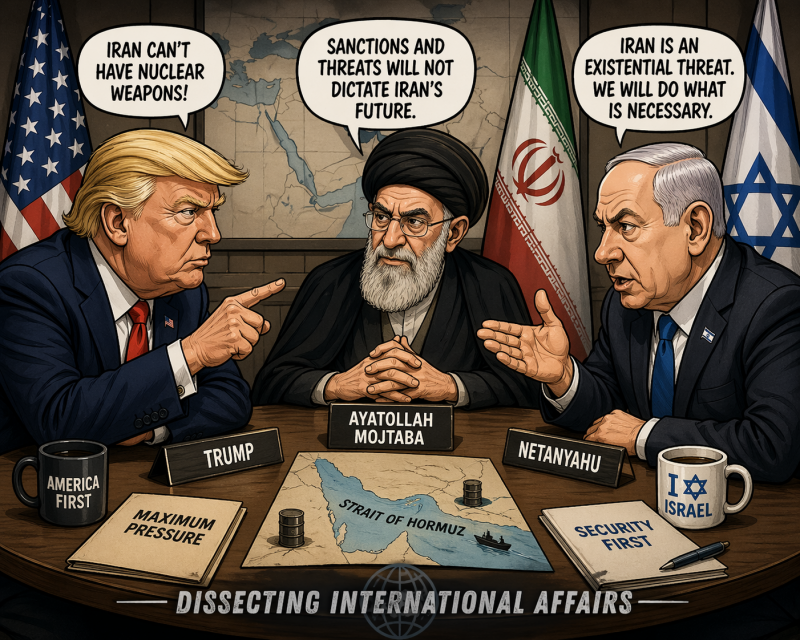
Earlier this month, the U.S.-Israel War on Iran saw its first prolonged ceasefire since hostilities began. Iran’s tightening grip over the Strait of Hormuz has been a notable byproduct of this war, with several authors offering a revealing lens into the evolving logic of the conflict. These authors show that what appears as a military standoff is, in reality, a deeper contest over control of global systems.
As Parisa Hafezi and Enas Alashray have found, the closure of the Strait of Hormuz following the US-Israel War on Iran has reinforced Iran's control of the major international trade route. The authors reaffirm how 'Iran flaunted its tightened grip over the Strait of Hormuz on Thursday with video of its commandos storming a huge cargo ship, after the collapse of peace talks that Washington had hoped would open the world's most important shipping corridor. Iranian state television broadcast footage overnight of masked troops pulling up in a grey speedboat alongside the MSC Francesca, climbing a rope ladder to a shell door in the hull and jumping through brandishing rifles ... The war, launched by the U.S. and Israel on February 28, has been paused since a ceasefire on April 8 but Israel warned on Thursday that it was ready to restart attacks. Israel's Defence Minister Israel Katz said Israel was waiting for a "green light" from the U.S. to resume the war, saying that if it did, it would begin by targeting Supreme Leader Ayatollah Mojtaba Khamenei and "return Iran to a dark age". "This time the attack will be different and deadly, delivering devastating blows in the most sensitive places," he said in a statement released by his office ... U.S. President Donald Trump said it was Washington that was in "total control" of the strait, which he described as "'Sealed up Tight,' until such time as Iran is able to make a DEAL!!!". Trump and his military officials have said Iran's navy is "at the bottom of the sea," but Tehran's speedboats show that it can still wreak havoc on shipping.' (Reuters.2026) As the authors have highlighted, the current trend of renewed Iranian aggression signals Tehran's continued ability to disrupt the Strait of Hormuz despite U.S. claims of naval dominance. The authors also point to an imminent threat of war. Following the collapse of peace talks, Israel has warned it is prepared to end the current ceasefire and "return Iran to a dark age" by targeting its supreme leadership. Moreover, President Trump maintains that the U.S. has "total control" over the corridor. There are conflicting narratives over which nation currently has dominance over the Strait of Hormuz, however it is increasingly evident that Iran holds the most significant control over this major shipping route, furthermore Iran’s tactical maneuvers suggest a high risk of renewed conflict in the world's most vital shipping lane.
These latest developments arrive as the U.S. President has ordered the navy to shoot any Iranian vessels laying mines on the Strait of Hormuz. An Al Jazeera report has found that U.S. President 'Trump ordered the United States Navy to “shoot and kill” any Iranian boat laying mines in the Strait of Hormuz, a move that could jeopardise the fragile ceasefire between the two countries. The US president also said on Thursday that the military will heighten its efforts to remove explosives from the strategic waterway ... “I have ordered the United States Navy to shoot and kill any boat, small boats though they may be (Their naval ships are ALL, 159 of them, at the bottom of the sea!), that is putting mines in the waters of the Strait of Hormuz. There is to be no hesitation,” Trump wrote in a social media post. “Additionally, our mine ‘sweepers’ are clearing the Strait right now. I am hereby ordering that activity to continue, but at a tripled-up level!” Iranian officials have repeatedly promised that their country would defend itself and respond to any US attack. Hormuz – which had been open without interruption before the war – has emerged as a major point of contention in this war. Iran closed down the strait in response to the US-Israeli military campaign, and it is now suggesting that it has rights to the passage that links the Gulf to the Indian Ocean – parts of which go through Iranian territorial waters.' (Al Jazeera.2026) These recent trends in the conflict demonstrate the increasingly aggressive rules of engagement, with the U.S. issuing "shoot and kill" orders on Iranian vessels, also the ramping up of U.S. minesweeping efforts and a clear geopolitical standoff between the nations involved. While the U.S. asserts total maritime dominance, Iran maintains its right to defend its territorial waters, placing the Strait of Hormuz as the primary breaking point for renewed conflict.
The current trajectory of the U.S.-Israel War on Iran is a return to hostilities as both sides have not shown clear and evident efforts to facilitate productive peace talks. The resolution of the Strait of Hormuz crisis could also set a precedent for how nations involved in asymmetric warfare can utilise their leverage through natural geography in turning the tide of conflicts they face.