October 23, 2026 - Dissecting the Implications of the Protests in France and Italy
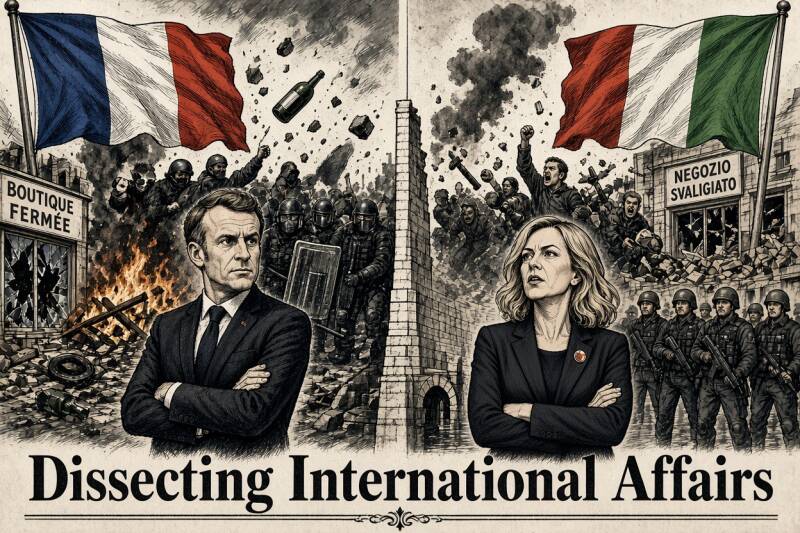
Over recent weeks, widespread protests and riots have affected both France and Italy, stemming in France from a student protest over dissatisfaction with education policies, austerity measures and broader socio-economic pressures. Comparatively, Italy faced protests over the structural problems with its education system, economic pressures and political resistance to the incumbent government. Various experts have raised concern over these demonstrations and discussed their possible implications.
Jon Henley spoke to the situation in France, noting ‘France will deploy about 70,000 police around the country on Saturday as the government seeks to prevent more civil unrest after some of the worst street violence in years erupted on the fringes of cost-of-living protests last weekend. The interior minister, Laurent Nuñez, said on Friday the security forces would include elite units usually used for counter-terrorism operations and hostage rescues, adding that there had been social media calls for violence from “ultra-left” groups. “We are not talking about a peaceful, friendly demonstration,” Nuñez told reporters after a meeting of senior ministers and officials chaired by the president, Emmanuel Macron. “We are ready tomorrow to be extremely firm and not tolerate anything.” Macron and his government are struggling to get on top of a crisis that has caught it off guard six months before presidential elections to choose his successor. The government has admitted it “lost control” over widespread rioting on Saturday … Protests are expected across France on Saturday, although several cities have banned demonstrations or forced them to change their planned routes to protect shops and public buildings, and forecast heavy rain and high winds could dampen turnout. The centres of Lyon and some other large cities will be off-limits to protesters, while authorities in Paris authorised a union march along a limited route in the east of the capital between the Places de la Bastille and Nation that will avoid the city centre. But requests for rallies in Paris organised by France’s main student union, UNEF, and the gilets jaunes movement, whose nationwide protests rocked France in 2018 and which plans 600 small-scale events around France on Saturday, were refused. UNEF said its rallies, which grew from high school protests last month against teacher shortages and dilapidated facilities, would go ahead regardless. Several of the best-known cultural institutions in Paris, including the Louvre, said they would close on Saturday … On Thursday, Macron called for “the utmost severity” against “acts of delinquency”, saying gangs of rioters had been mainly responsible for the looting but the worst violence was caused by “ultra-left” groups seeking to “bring down the republic”. Further stoking disquiet, one person was killed and four others injured – including a 12-year-old girl – in a shooting in the town of Trappes, west of Paris, on Friday in an attack that police said could have been racially motivated’ (The Guardian.2026). As Henley has ascertained, France will be robust in their response to the recent riots, deploying roughly 70,000 police officers, including elite counter-terrorism units to prevent further escalation of violence. Authorities have also banned several planned demonstrations, including those requested by student union UNEF. UNEF suggested their rallies will continue in spite of these bans. President Macron is facing mounting political pressure six months before presidential elections, and his government has pledged extreme firmness against “ultra-left” groups and rioters blamed for the recent riots and looting.
Italy has faced similar pressures, as Arnold Koka has found, ‘nationwide protests against the rising cost of living are expected in Italy and France on Saturday 24 October. Authorities and business owners fear a repeat of what happened on 17 and 18 October, when hundreds of people were involved in violent incidents targeting shops and law enforcement. Protests are planned in several Italian cities, including Milan, Bologna, Genoa, Turin, Rome and Florence. According to "Mappa della rivolta", a website that collates protest initiatives, more than 30 mobilisations are scheduled, ranging from marches and sit-ins to assemblies and strikes. The capital will be under tight security for the occasion. Rome's police headquarters has drawn up a security plan to manage both notified demonstrations and spontaneous rallies announced online. In addition to the usual units deployed to handle protests, drones from the State Police's 1st Flight Department and aircraft from the Carabinieri will also be used. In all, around 1,500 officers will be deployed, with checks stretching from city squares to railway stations’ (Euronews.2026). As Koka finds, protests in Italy originated over cost of living pressure which evolved into full scale rioting and looting, with more protests planned across major cities throughout Italy. The widespread unrest that besieged Italy earlier this week has driven Italy's Prime Minister to strongly admonish protesters and warn of severe consequences. Italy’s Prime Minister Giorgia Meloni has announced tough measures to combat these recent escalations of violence with Giuseppe Fonte, Emilio Parodi and Anna Uras identifying how ‘Italy approved a raft of security measures on Tuesday including a new offence of violent participation in a demonstration, tougher penalties for rioters, and financial liability for parents whose children take part in vandalism and looting … "There is nothing revolutionary about vandalising and stealing. Vandalism and theft are not protest, they are criminality," Prime Minister Giorgia Meloni said on social media, unveiling the decree. As part of the package, which comes into immediate effect, anyone who takes part in a group of at least five people and endangers public safety during protests faces up to five years in prison and a maximum fine of €20,000 ($22,460). Penalties increase if faces are concealed or people injured. Authorities are empowered to order prompt compensation for any damage inflicted and, in the case of minors, their parents will be held liable.Police will be allowed to detain youths aged between 14 and 17, even if they have not committed a crime, provided there is evidence they pose a danger, extending powers that previously applied only to adults. While authorities fear further unrest at demonstrations planned for Saturday, the government said it would deploy 500 army troops alongside the police in Milan until the end of 2026. The military will help reinforce security at key sites, step up surveillance of sensitive locations and enhance monitoring across the area, the defence ministry said in a statement … The disturbances in northern Italy echoed riots in neighbouring France, where hundreds of thousands of people took to the streets on Saturday in some of the country's most violent turmoil in years. Meloni has passed a steady stream of security crackdowns since taking office in 2022, which critics say do little to address the underlying causes of crime and disorder. Italy's prison population has increased by more than 17% over four years, or nearly 10,000 people, government data shows. Meloni's government is also facing mounting pressure from a separate wave of protests in southern Italy, where truck drivers angered by soaring diesel prices and the rising cost of living have staged roadblocks that are disrupting supply chains’ (Reuters.2026). As the authors have observed, Italian Prime Minister Giorgia Meloni’s government has approved strict new security measures including severe fines, up to five years in prison for violent demonstration, parent liability for minor vandalism, and expanded police detention powers to crack down on criminality during protests. In response to recent unrest that mirrored riots in France and ongoing truck driver roadblocks in southern Italy, the government is also deploying 500 army troops alongside police in Milan through the end of 2026. Meloni argues that vandalism and theft are crimes rather than legitimate protest, however, critics argue her continuous security crackdowns fail to address the underlying causes of social disorder.
Recent riots and protests in France and Italy have highlighted how initial student grievances over educational conditions have rapidly merged with widespread public anger over rising living costs and inflation. Both the French and Italian governments have employed severe state deterrence to mitigate the spread of violence, deploying thousands of security personnel, elite units, and military forces alongside strict bans and newly enforceable criminal penalties. These hardline tactics risk deepening political polarisation and sparking further defiance from activist groups like UNEF, who pledge to protest despite active bans. How France handles this crisis has direct implications for President Macron’s final months in office and the prospects of his potential successor, while criticism will increasingly be levied against Italy’s Giorgia Meloni for prioritising punitive crackdowns over systemic social relief. Ultimately, these cross-border crises signal a growing vulnerability across Europe under severe socioeconomic pressure; if left unaddressed by government policy, the situation could deteriorate further and destabilise public order, testing the limits of democratic governance.