June 23, 2026 - Dissecting the Implications of the U.S.-Iran Peace Deal
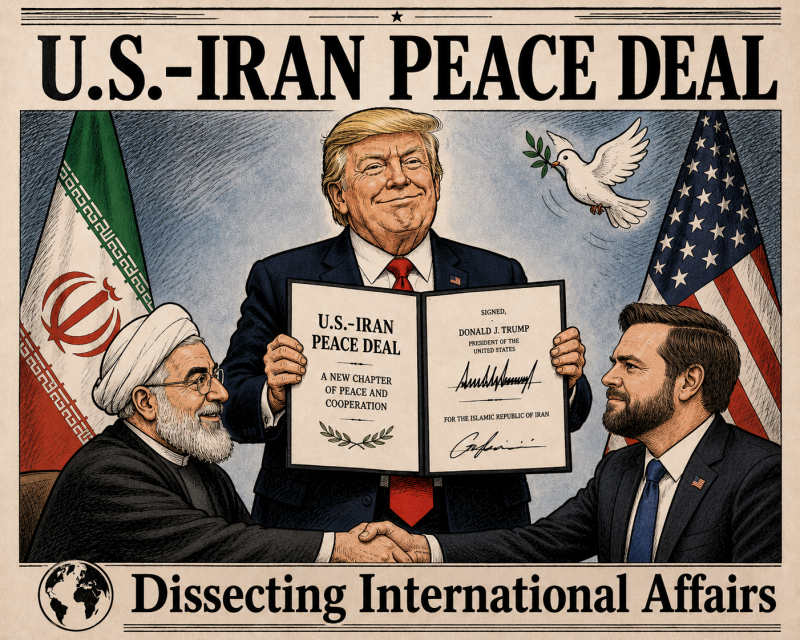
Earlier this month, Donald Trump signed a 14-point agreement with Iran, signalling a clear opportunity for a concrete pathway to peace. Scholars and experts have remarked on what this means for peace and security in the region.
As Andrew Roth and Patrick Wintour have conveyed, 'Donald Trump has signed a 14-point agreement with Iran, claiming it delivered a “major win” for the United States – even as it made significant political and financial concessions to Iran to reopen the strait of Hormuz and prevent a “worldwide depression” In extraordinary remarks on Wednesday, Donald Trump went from threatening Iran with a new wave of attacks to suggesting the country had basic rights to enrich uranium for civilian use, that he would not pressure Tehran to abandon its ballistic missiles programme and the US was “going to have to give back” billions of dollars in frozen Iranian assets.Iran’s president, Masoud Pezeshkian, signed the agreement on Wednesday from Tehran. The US vice-president, JD Vance, is also expected to sign the deal at a more formal ceremony in Geneva on Friday. Iran’s chief negotiator, Mohammad Bagher Ghalibaf, said: “The agreement is a record of US failure. People will see it and judge.” Defending the deal, Trump said no US president had ever been as tough on Iran as him, and “there is nothing as smart as the market – and the market loves it”. Trump said that “the alternative would be a worldwide depression”, arguing that if he had not struck a deal, “the strait [of Hormuz] would never have been opened. They don’t like floating billion-dollar ships up and down the strait when their rockets are flying overhead and there are mines all over the place … The G7 leaders said the agreement provided “a historic opportunity to prevent Iran from acquiring any nuclear weapon and tackling the threats related to its regional and ballistic activities. We support and are ready to contribute to its implementation.” Trump also sounded a conciliatory note on returning frozen assets to Iran, a stipulation of the Obama administration’s Joint Comprehensive Plan of Action that he had attacked in 2015. “We have taken a lot of their money,” Trump told reporters. “It’s not our money, it’s their money, and we froze it at a certain point in time. I guess we’re going to have to give it back, you know, if we didn’t give it back, nobody would ever invest in the dollar again.” Trump claimed the price of a barrel of oil had fallen to $72 – Brent crude dipped below $80 on Tuesday – and would soon fall below the level it had been at before the war.' (The Guardian.2026). As the authors have established, The US announced a 14-point agreement with Iran, describing it as a major victory that would reopen the Strait of Hormuz and avert a global economic crisis. Although the tone was optimistic, the fine details of the plan reportedly include major concessions, such as allowing civilian uranium enrichment, easing pressure on Iran’s ballistic missile programme, and returning frozen Iranian assets. While Trump and G7 leaders praised the agreement, Iranian officials portrayed it as evidence of US failure.
There have been reports on disapproval over the peace deal by Israeli leadership figures and citizens. As Jason Burke has found ‘In the Tree brasserie off Herzl Street in Rehovot, there was much that almost everyone agreed on. Few contested that the ceasefire deal concluded by Iran and the US a few days earlier was very bad for Israel. “We were betrayed by President Trump,” said Avi Perez, 55. They believed, too, that Israel, more than ever, was surrounded by danger that it would have to confront alone. “It is strange. One day we were in the [bomb] shelters with our children … The next day, everything is supposed to be normal. But nothing has been resolved,” said Shaham Nowick, 35, as he studied the menu … In Metulla, a northern town metres from Lebanon, there was anger. “Everyone was very pleased with the war [against Iran] but the US agreement is really not good for Israel … It’s a big mistake,” said Daniel Dorfmann, a restaurateur. Others spoke of the “abject failure” of Israel to achieve its war aims of regime change, the destruction of Iran’s nuclear programme and the elimination of its ballistic missiles. Worse, after starting the war “shoulder to shoulder” with the US, Israel had ended the conflict marginalised by Washington and dismissed as “a small power” by Donald Trump last week. Instead of being invited to the White House to advise Trump, Benjamin Netanyahu has received expletive-laden tirades and criticism over the civilian casualties caused by Israel’s relentless offensive in Lebanon, where more than 3,900 people have been killed.’ (The Guardian.2026) As Burke has found, many Israelis viewed the US-Iran ceasefire agreement as a betrayal, arguing that it failed to eliminate Iran’s nuclear and missile capabilities and left Israel facing unresolved security threats. Residents and commentators expressed frustration that Israel had not achieved its war aims and had emerged politically isolated, with relations between Donald Trump and Benjamin Netanyahu reportedly strained. Critics also pointed to growing US disapproval of Israel’s conduct in Lebanon and a perception that Washington had sidelined Israeli interests.
It remains to be seen how the peace plan unfolds, whether it leads to lasting peace is contingent on various factors including Israel being fully on board. Currently, the evidence points to the fact that Israeli leadership figures are firmly against the deal. Israel’s opposition to the deal could complicate its implementation and strain US-Israeli relations, as Israeli leaders may seek to undermine or act independently against Iran if they believe the agreement leaves critical threats intact. Such divergence increases the risk of unilateral Israeli military action and could weaken regional stability by exposing the tensions between Washington and its closest Middle Eastern ally.