July 23, 2026 - Dissecting the Rising Xenophobia and Anti-Immigrant Protests in South Africa
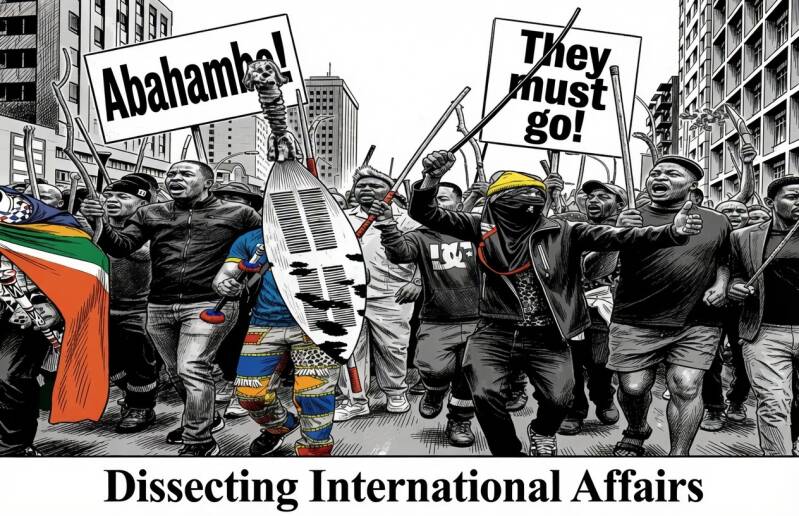
There has been a sharp rise in anti-immigrant violence and protests in South Africa in recent weeks. Various anti-immigrant groups have been ratcheting up tensions against foreigners in the nation, many protests bearing the poster and slogans ‘Abahambe!’ or ‘They must go!’. The situation is escalating with nearly one thousand arrests in recent days.
Various experts have voiced their concern over the rising violence in the nation. As AFP and Reuters report, ‘South African police have arrested more than 900 people during nationwide antimigrant protests that were mostly peaceful but at times turned violent with shops looted and one person shot dead. The demonstrations on Tuesday were organised by a coalition of more than 20 civil society groups, including the March and March movement. They were called to mark an unofficial “deadline” for undocumented migrants to leave the country. A statement issued by the Presidency said President Cyril Ramaphosa held an emergency meeting on Monday with key protest organisers to call for calm. In the statement Ramaphosa acknowledged the core grievances of the demonstrators, writing: “South Africans have raised deep concerns about illegal immigration, border management, pressure on public services. … These concerns are real, and they deserve to be heard.” However, the president drew a line at unlawful behaviour. “Whatever the motivation, taking the law into one’s own hands is vigilantism and has no place in our constitutional democracy”' (Al Jazeera.2026). As the authors have found, South African police arrested more than 900 people during nationwide anti-immigration protests that were largely peaceful but included incidents of violence, looting, and one fatal shooting. The demonstrations, organised by a coalition of over 20 civil society groups, called for undocumented migrants to leave the country and highlighted concerns about illegal immigration, border security, and pressure on public services. President Cyril Ramaphosa acknowledged these concerns as legitimate but condemned vigilantism, urging protesters to respect the rule of law.
The protesters are demanding that all undocumented foreigners leave the country, with many African nations beginning the process of repatriating their citizens. As Nomsa Maseko, Khanyisile Ngcobo, Farouk Chothia and Hafsa Khalil have found, ‘many foreigners have already fled to escape violence and intimidation. South African police say 25,000 have been repatriated so far. Most are from other African countries. One undocumented Malawian told the BBC he was "happy to be going back" but "heartbroken" to be leaving behind four young children … The leader of anti-migrant group March and March, Jacinta Ngobese-Zuma, said they would protest every Thursday for the next six months to force the government to "get rid of" undocumented migrants who were still in South Africa. A demonstrator - who is part of another anti-migrant group, Operation Dudula - told the BBC they would "push the police" to arrest foreigners who are not legally in the country. President Cyril Ramaphosa met some of the protest leaders on the eve of Tuesday's marches to defuse tensions … Many African migrants moved to South Africa around the time white-minority rule ended in 1994, hoping for a better life. But with South Africa facing an unemployment rate of more than 30%, anti-migrant sentiments have risen. Nigeria flew out 269 of its citizens on the eve of the protests, bringing to around 600 the number evacuated so far to the West African nation. More evacuations are expected to take place in the coming days. Ghana, Malawi, Mozambique and Zimbabwe have also been repatriating their citizens by plane or bus. Ahead of the deadline, thousands of migrants have been awaiting processing in temporary camps for several weeks out of fear for their safety’ (BBC.2026). As the BBC has found, thousands of undocumented migrants are seeking repatriation or shelter in temporary camps, with more than 25,000 already returned to their home countries. Protest leaders vowed to continue weekly demonstrations demanding the removal of undocumented migrants, while President Cyril Ramaphosa met organisers in an effort to reduce tensions. The unrest reflects growing anti-migrant sentiment linked to South Africa's high unemployment, with several African countries including Nigeria, Malawi, Ghana, Mozambique and Zimbabwe repatriating their citizens.
It is evident that the situation in South Africa remains highly volatile, with anti-migrant protests showing little sign of subsiding in the coming months. The South African government has acknowledged public concerns over illegal immigration, it has also warned that violence and vigilantism cannot be tolerated under the rule of law. As thousands of migrants continue to leave the country or seek refuge amid fears for their safety, the crisis is placing increasing pressure on both South Africa and neighbouring nations. Without a balanced approach that addresses border management, economic hardship, and community tensions, the risk of further unrest and humanitarian consequences is likely to escalate further.